Imagine you are sitting in the bleachers at a high school basketball game and notice a man sitting a few rows in front of you, closer to the floor. You have never seen him before, but it seems like everyone else knows him. One person after another speaks to him as they pass by and continue to their seat. Hey, how are you? Good to see you. It feels strange that everyone knows him but you. Some stop and talk for several minutes as if they are old friends. One man stops and shakes his hand. A little boy ran up and gave him a hug.
Finally, you ask your friend, Who is that guy?
He responds, You don’t know him? You should get to know him. He’s a good guy.
What does he do?
I don’t know.
Where is he from?
I don’t know.
How old is he?
I don’t know.
Finally, you say, You keep saying I need to know him, but you haven’t told me anything about him.
And your friend answers, He’s right there in front of you. You just need to go meet him. Once you do, you’ll get to know him.
There are a couple simple truths in this little story. You cannot really know someone unless they make themselves known to you. You can see them from a distance, you can make guesses about them, and you can hear what others say about them. But if they have revealed themselves, and you want to know them, then you must take a step closer toward meeting them.
This is one of the things that makes God so amazing. He wants to be known. He is not sitting in heaven saying, Try your best to figure me out. Take a guess. He has gone out of His way to make Himself known to us. We can look at things in our world and learn about Him. We can look in Scripture and learn even more about Him: Who He is, What He has done, and What He wants from us. And, ultimately, we can look at Jesus.
God Has Not Hidden Himself
When Paul entered Athens in Acts 17, he was amazed to walk into a city full of idols. He found idols to every deity one could dream of. He was amazed because not one of these deities ever revealed itself to the world. Instead, men’s imaginations and hands carved or forged the idols into existence. He was amazed because among them was even an altar dedicated To the unknown god. That is, just in case there was a deity out there that they had overlooked, they had built an altar for him so that they would not neglect to honor him. Paul wanted to talk to them about the God they did not know, who created man. He told them, What therefore you worship as unknown, this I proclaim to you.
Then he began with the world around them. God who made the world and everything in it…gives to all mankind life and breath and everything. And he made from one man every nation of mankind…that they should seek God, and perhaps feel their way toward him and find him. Then Paul added something beautiful: Yet he is actually not far from each one of us. God is not playing hide-and-seek with mankind. He has moved toward us. The question is whether we will move closer to Him, to meet Him, and come to know Him.
Creation Has a Creator
Have you ever considered why mankind is interested in the existence of God? Humans are curious creatures. We want to know, and we have the ability to figure things out in a rational and logical way. It begins when we are small children, pointing and asking mama: What is that? We see a storm and ask: How did that happen? We see an engine and ask: How does it work? It is natural for us also to ask about ourselves. Where did we come from? Are we an accident or an intentional creation? Why are we here? Is there a purpose for me? What is right and wrong? Who determines what is right? What happens after we die? Will it be eternal nothingness or something? There’s another reason we ask most of these questions: We are looking for something better. Most of us have a blessed life, and we are thankful for that. But it has not always been easy. There has been hurt. At times it has been painful. If we live long enough, we will likely experience pain again. We want to be somewhere where we never feel that pain.
The Bible opens with a remarkably simple statement: In the beginning, God created the heavens and the earth (Genesis 1:1). Later, it also says: The heavens declare the glory of God (Psalm 19:1). The world is not God. The world is not Scripture. However, creation does speak. Its most basic message is this: Creation has a Creator. We understand this kind of reasoning every day. A building has a builder, a book has an author, a song has a songwriter, and a painting has a painter. When we encounter something that exists, it is natural for us to ask where it came from.
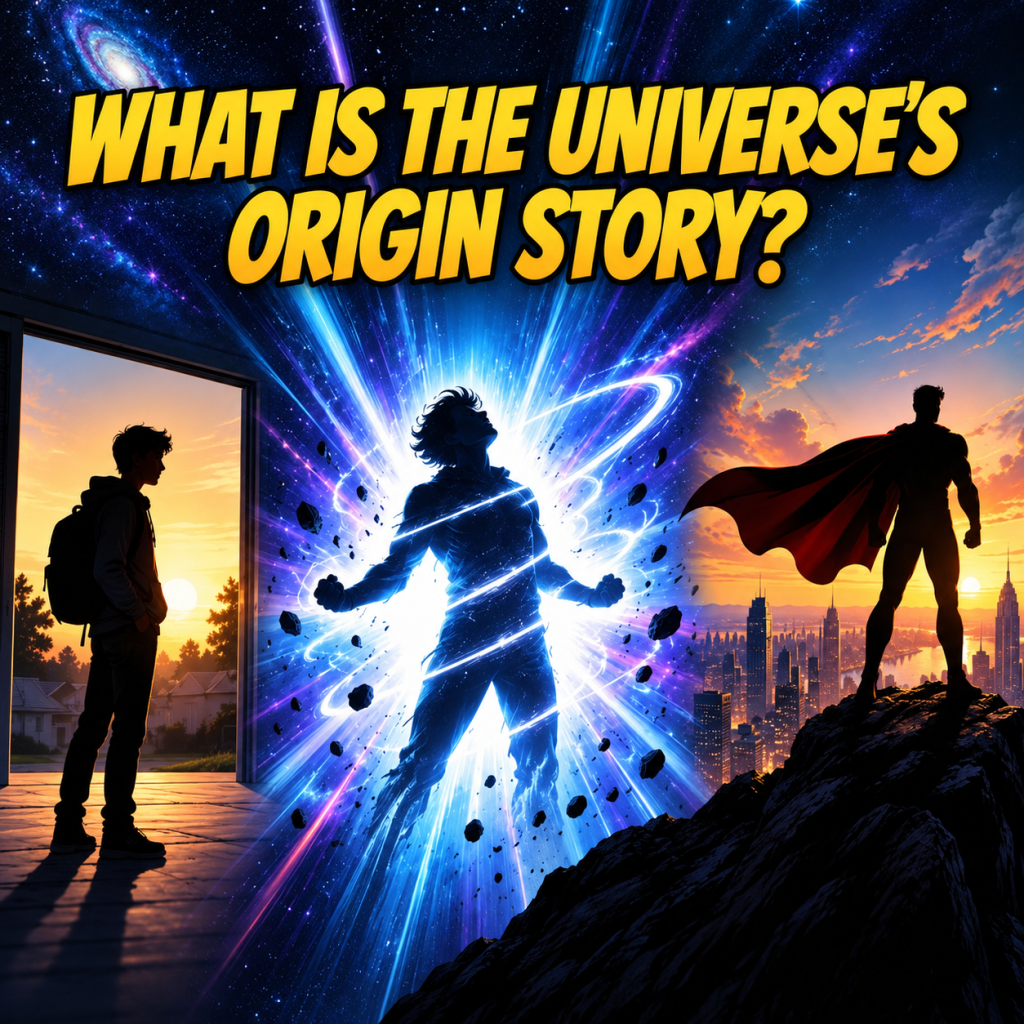
One way of thinking about creation is what is called the Cause Argument, or the Cosmological Argument. The idea is simple: something that begins to exist does not come from nothing. We understand the things around us have causes or sources. So we look at the universe itself and ask: What is its origin story?
I’ve heard our children talk about going to the theater to see origin story movies. Every superhero has an origin story. How did Superman become Superman? The same idea is true with our universe. It exists, so it must have a cause. Within our universe we find time, space, matter, and energy. We find stars, planets, the earth, and human beings. Where did all of it come from?
Often, it seems some of the theories of how the universe developed do not, by themselves, answer the deepest question of why there was something here to develop in the first place. In contrast, the creation story begins one step further back: In the beginning, God created… God is not presented as another object within the universe needing an explanation from something else within it. He is the eternal Creator. He is the explanation for everything else that has begun to exist. The creation story explains why there was something here to develop in the first place. It explains time (In the beginning), space (God created the heavens), matter (and the earth), and energy (and God said).
That only answers the first question. The creation story tells us Creation has a Creator. Look around at our world. The universe does not merely exist. It works really, really well. There is order, arrangement, and purpose all around us. Even our own bodies are made up of incredibly complex systems that work extremely well together. The next, most natural question should be: Why does everything work so well? If creation points to a Creator, then what does design tell us about Him?


Leave a comment