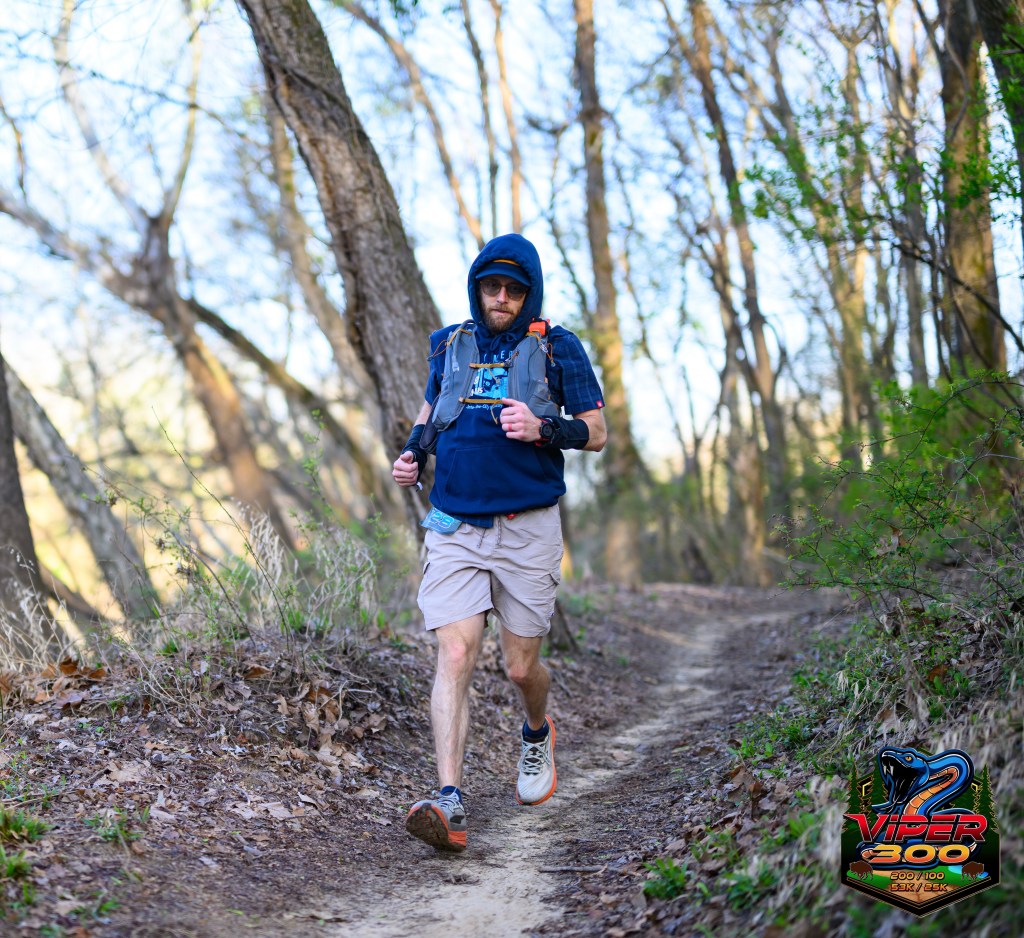
The runners around me were disappearing. There was a big climb within the first half mile of the race. I slowed and walked; others ran up the hill. Then there were a few fast miles of greenway before we hit the first trail. As we entered the trail, one by one, they were pulling away from me. I kept telling myself not to worry. The temptation to chase them was enticing. But I’ve done that before, and it does not work. I can’t hold their pace. Just stick to the plan. It may turn out they can’t hold that pace either. There is something psychologically difficult about deliberately watching people run away from you when you are supposed to be racing them.
The Viper 100 is a 100 mile running race that takes place in Shelby Farms in Memphis, Tennessee. After watching my son’s XC team race there in the state championship the past couple years, I knew this was a course I wanted to race also. It is a 33.4 mile loop of both greenway and trail, and we had to run it three times. The race director was fantastic, the three aid stations on the course were excellent, and the volunteers were amazing. I saw deer, a herd of buffalo, and no snakes. I hate snakes! This was the best racing decision I made in 2026.
I had a plan. I called it the 1:4 Plan. Run one minute, walk 4 minutes. Repeat. When I come to a hill, walk up it, and then resume the 1:4. When on greenway straights or downhills, jog them, and then resume the 1:4 on the trails. Walk through the aid stations and take what I need without lingering, and spend no more than 15 minutes in between loops. I wasn’t trying to run the pace that looks impressive at mile 5. I was trying to run the pace I believed I could still be running at mile 80, if not beyond. And eventually, I started passing people. In fact, I passed all but six of the runners in the race. Most of the people who had disappeared ahead of me couldn’t hold their pace. I had a pace I could hold onto. That’s a running lesson that has taken many painful years to learn. But during this race, I learned that holding your pace is not something you always do alone.
A pace isn’t useful if you can’t hold onto it. Starting fast feels good; holding steady isn’t nearly as exciting. My trail running history is extremely limited. I entered a 50 mile trail race in 2018, and then said never again! It was painful. I did zero research about strategy. I assumed it was like a marathon, but longer. Younger, inexperienced Jon tried to just keep running. The trail was covered in snow at the beginning, and a muddy mess by the end. It was nonstop, side-to-side and up-and-down movement around mud and over roots. The Just keep running strategy collapsed after 17 miles. And then it hurt. It became a run:walk. Then a walk. Finally, it hurt less to jog than to walk. As I crossed the finish line, they gave me a buckle! Not a medal to hang somewhere, but a buckle. That was cool. Best of all, being that I couldn’t hardly move any longer…my wife was waiting with the car about ten steps beyond the finish line, to take me to Cracker Barrel. That was the best Momma’s French Toast Breakfast of all time!
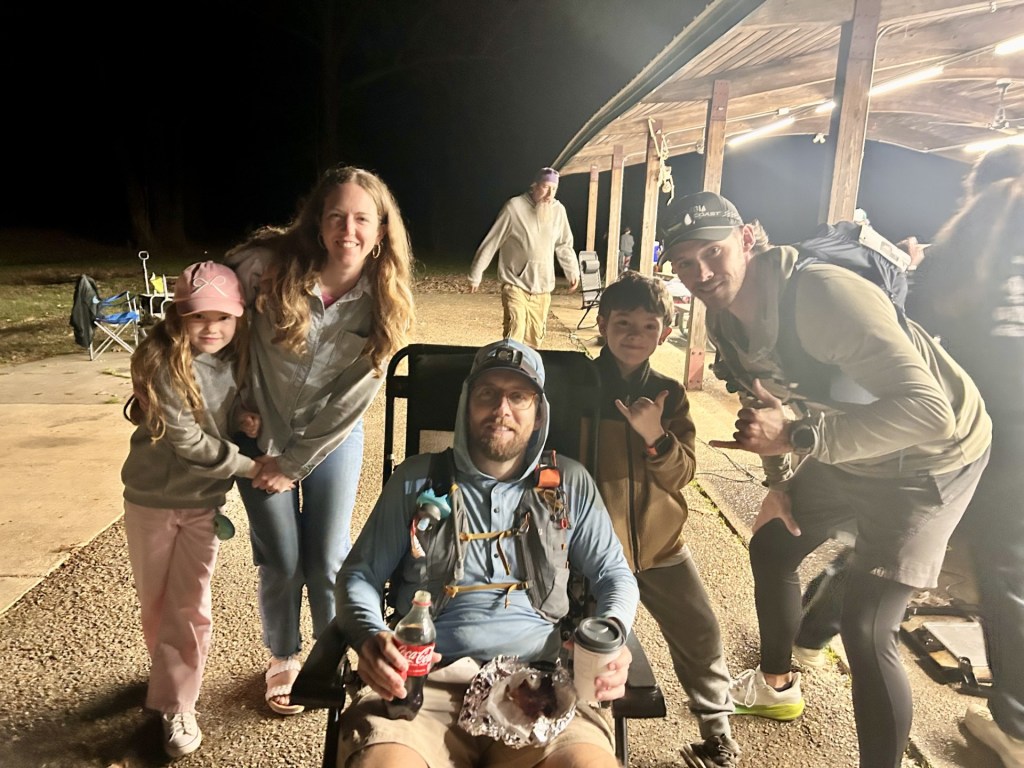
Fast forward to 2026. I believe the emotional highlight of the Viper 100 was that I did not run 100 miles alone. I had a crew. I’ve never really had a crew for a race before. I’ve always felt bad about asking others to be inconvenienced in order to help me do something that is, ultimately, not all that important. At Viper, I had my wife, a friend, and his family. But they were not merely crew; they were part of my ability to stick to the plan. 15 minutes. My friend’s son took this far more literally than I intended, and that was just what I needed. It took me a moment to realize what he was doing. Following the first lap, as I was changing socks and refueling, I heard him say 5 minutes. Then 10 minutes, 13 minutes, 14 minutes… It was time to set out for lap two. Just prior to reaching the aid station at mile 60, my wife had texted and asked what I would really like to have waiting on me. I’d love to sit down in my zero-gravity chair for just a few minutes, and drink a good, hot coffee. As I pulled into the aid station, my chair and coffee were waiting. When I was struggling to bend down and clean my feet at the aid station at mile 66, my buddy did it for me. He got a real thrill out of telling me he was washing my feet just as Jesus did his disciples! Are you hungry? Are you thirsty? What would you like? We’ll get it for you. Then, 13 minutes…Would you like a peanut butter and jelly quesadilla? 14 minutes…I’ve never wanted a peanut butter and jelly quesadilla before, but, yes, I do want that. 15 minutes…Mr. Jon, it’s time for you to go.
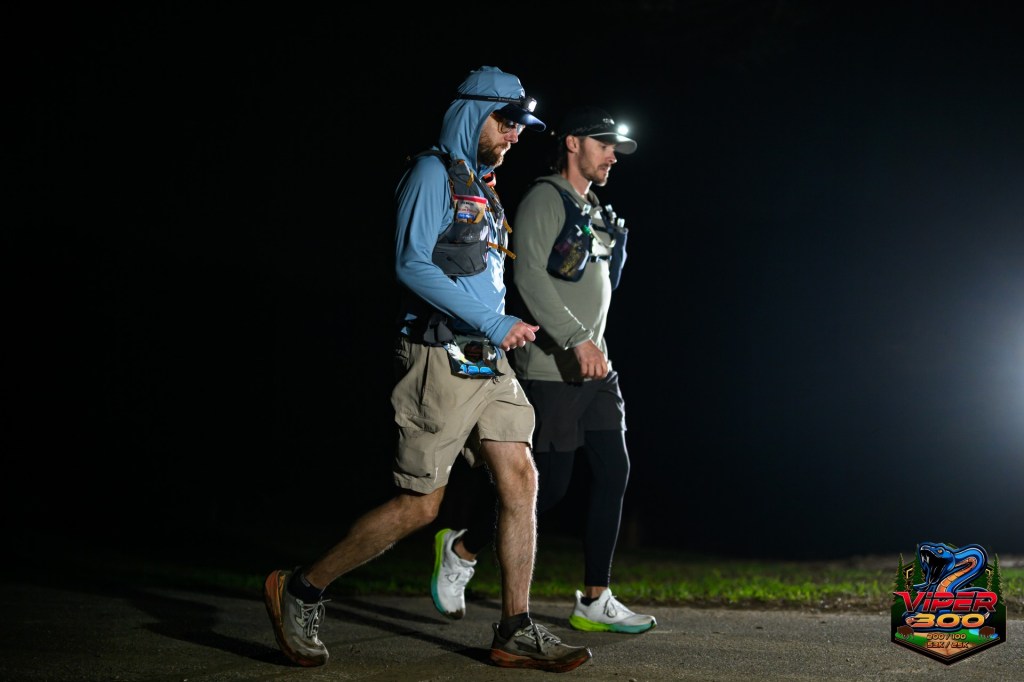
For the final loop, I had a benefit I’ve never experienced before: a pacer. My friend transitioned from crew to pacer, and joined me all the way to the finish. In fact, since his previous long run was 35 miles, and he wanted to beat that, he received permission from the race director to join me from mile 60 all the way to the finish. Why would a runner need a pacer after running all those miles without one? Because that’s when the danger is greatest to drop off, abandon the plan, or quit altogether. That final loop is going to hurt. That’s when both mind and body are telling you to stop. That’s when you need someone to push you to hold the pace, stick to the plan, all the way to the finish. As we entered the trail, I wondered why he was running so closely behind me, and why he kept tripping over tree roots. He had forgotten to charge his headlamp. But he kept right with me. And, fortunately, he kept talking the entire time. Those late night/early morning hours are tough to push through. But he kept asking questions that took my mind away from being sleepy. When I sat down in a chair at the mile 76 aid station, and wanted to linger just a little too long, there was his voice, saying, Time to move, bud.
Whether it was my crew or my pacer, here’s the thing: they were watching out for me when I was too tired to watch out for myself. I’ve been studying Hebrews 3:12-15 this week in preparation for a Sunday sermon, and it has caused me to think about my experience at the Viper 100.
12Take care, brothers, lest there be in any of you an evil, unbelieving heart, leading you to fall away from the living God. 13But exhort one another every day, as long as it is called “today,” that none of you may be hardened by the deceitfulness of sin. 14For we have come to share in Christ, if indeed we hold our original confidence firm to the end. 15As it is said, “Today, if you hear his voice, do not harden your hearts as in the rebellion.”
There are some parallels worth noticing. Most people do not suddenly decide one morning to abandon the living God. More often, it happens gradually. A little less Jesus here and a little more tolerance of sin there. All the while, we tell ourselves: It’s not that big a deal…I’m still doing better than most people. That’s the deceptiveness of sin. But the writer gave us something to do about it: exhort one another daily. One of the beautiful aspects of the church is that we need others looking out for us. We exhort one another. And since sin works gradually, that exhortation must also be continual. My crew is a good example of this exhortation. They did not give me one encouraging speech and then disappear. They kept watching. They kept asking what I needed. They kept telling me when it was time to move. Hebrews says exhort one another every day because perseverance is not won by one great moment of encouragement. We need people who keep showing up.
Notice verse 14: if indeed we hold our original confidence firm to the end. The Christian life is about perseverance. It’s about holding on to the pace. At Viper, everyone else started out fast and left me in their dust, but most were unable to hold onto that pace. Don’t confuse starting fast with finishing faithfully. The Christian life isn’t about how strongly you start; it’s about holding firmly to Jesus so we can make it to the finish. And, often, we need a crew and pacer to watch out for us when we are too weak to watch out for ourselves.
At mile 80, it was ok for the pace to change. I had held onto the 1:4 pace for 80 miles, and I was way ahead of the overall goal for my race. I had accomplished more than I had expected, and this gave me the opportunity to reassess the situation. My knee was inflamed, and those 1-minute runs were becoming painful. In the stupor of the early morning hours and darkness, my pain meds accidentally got tossed in a trash can. However, I had not had a single muscle cramp the entire race. I wasn’t falling apart at all, but I was beginning to recognize that continuing to push the pace could now cost me the goal. We talked, we calculated, and I realized I could walk the next 20 miles and still beat the goal I had set for myself. In this decision, I realized that sometimes perseverance doesn’t mean pushing harder. Sometimes perseverance means having the wisdom to change your pace. I wasn’t abandoning the goal. I was adjusting the strategy so that I could hold onto the goal all the way to the finish.
Those last 20 miles were not easy. The final 8 were brutal. I had been awake all night and morning had arrived. My body was tired and my knee was hurting. I had been moving for an enormous amount of time. Having a crew and pacer was a game changer. They couldn’t run the race for me. They couldn’t make my legs move. And they couldn’t take away the pain. But they were there. And they encouraged me to keep moving toward the finish. Sometimes what we need most isn’t someone to carry us to the finish. We need someone willing to walk beside us until we get there.
I’ve thought about the Viper 100 a lot since March. I’ve thought about it because I believe the lessons learned were not really about running. My crew didn’t just encourage me. They exhorted me. They watched the clock and told me when it was time to move. They provided what I needed and helped me make difficult decisions. That’s the kind of relational Christianity Hebrews 3 says is necessary to help us hold on until the finish. We tend to think about faith as something incredibly personal. In a sense, it is. But following Christ is never described as something we have to do alone. We need people who know us well enough to notice when we are struggling. We need people who love us enough to tell us when we are making a wrong turn. We need people who will encourage us to move, tell us to slow down, and stick with us when the final miles are painful. Sometimes faithfulness means resisting the temptation to chase someone else’s pace. Sometimes it means changing your pace so you can keep moving. Sometimes it means allowing someone else to walk beside you. Hold onto Christ. Hold onto the pace. Keep moving toward the finish.


Leave a Reply